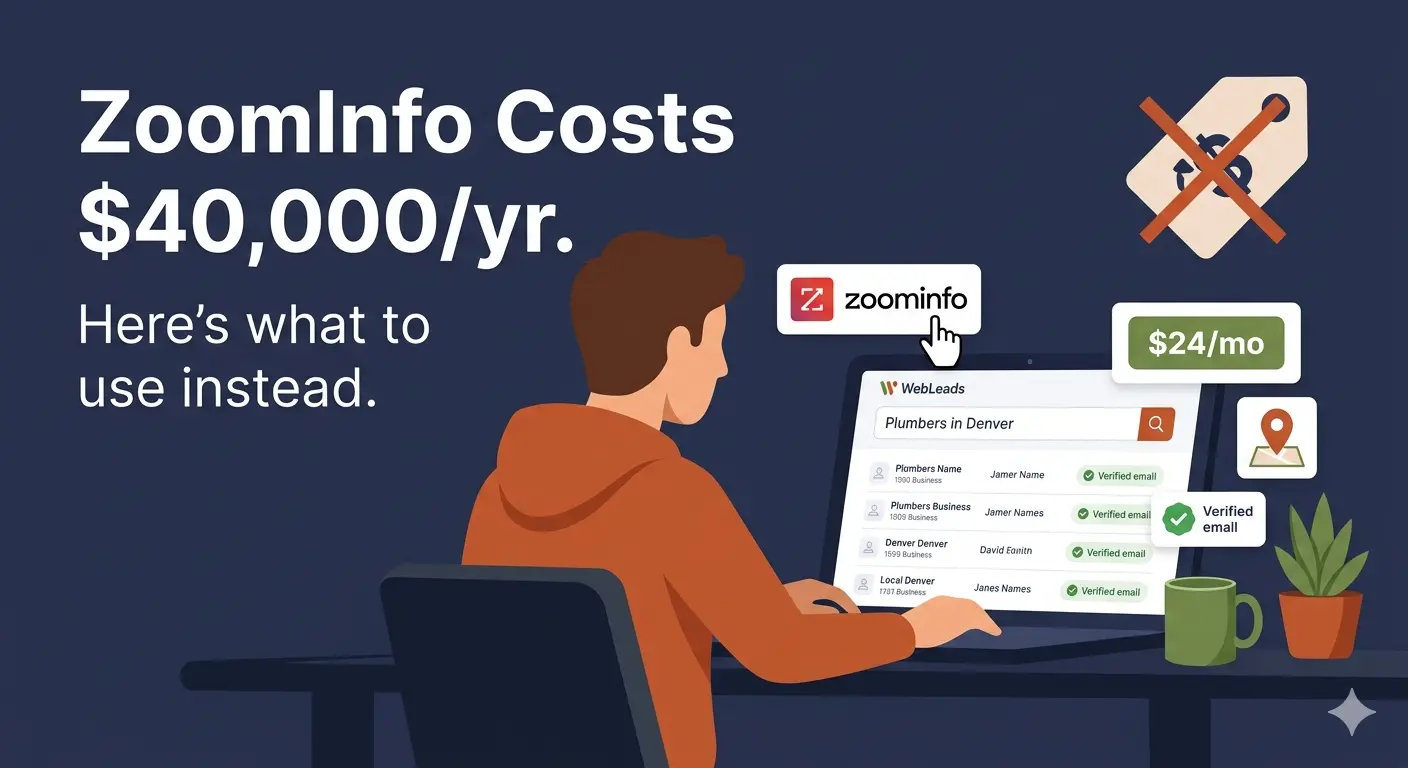
5 Best ZoomInfo Alternatives for Local Business Prospecting (2026)
You're Paying Enterprise Pricing for Local Leads. Here's Why That's the Problem
ZoomInfo charges $10,000 to $40,000+ per year. That price tag makes sense if you're a 50-person sales team at a mid-market SaaS company prospecting Fortune 500 targets with intent data and org charts.
But if you're a freelancer, small agency, or founder doing cold outreach to local restaurants, contractors, and service businesses? You're paying for a Ferrari to drive to the grocery store.
The gap between ZoomInfo's enterprise positioning and local business needs is real. ZoomInfo's database is massive and deep, but it's built for enterprise sales teams with budget. Their "search" workflow isn't designed for "find all plumbers in Denver." Their decision maker data comes from corporate org charts, which don't exist for local businesses. And their pricing assumes you're buying per-seat for a team.
If you're searching for local businesses, you need different tools. That's not a knock on ZoomInfo. It's an acknowledgment that the market has evolved. Teams building local outreach now have options that are cheaper, faster, and better suited to SMB prospecting.
This guide covers five solid alternatives, including when ZoomInfo is still the right choice.
What ZoomInfo Does Really Well (And Why People Love It)
Before we talk about alternatives, let's be honest: ZoomInfo is the gold standard for enterprise B2B prospecting for a reason.
Massive database: ZoomInfo covers millions of companies and decision makers, with data on company technology, funding, hiring, and org structure. If you're selling to mid-market and enterprise, their coverage is exceptional.
Intent data: They track buying signals: job postings, funding announcements, technographics, buying group changes. If you're selling enterprise software, knowing a prospect is actively hiring is valuable.
Org charts: For mid-market and up, ZoomInfo has detailed organizational hierarchies. You can see the full buying committee, not just a CEO name from LinkedIn.
Multi-channel engagement: Integrated email, phone, LinkedIn, and intent signals in one platform. If you're managing a sales team, this cohesion is powerful.
CRM integrations: Deep native integrations with Salesforce, HubSpot, and other tools. Workflows are built in.
Data quality: For the types of companies they focus on (10+ employees), their data is accurate and regularly updated.
So here's the honest take: If you're doing enterprise B2B sales, ZoomInfo is still one of the best tools. The issue isn't with ZoomInfo. Not everyone needs what ZoomInfo offers.
Where ZoomInfo Falls Short for Local Business Prospecting
ZoomInfo's limitations become clear when you step outside enterprise sales:
1. Local Business Coverage is Weak
ZoomInfo's database prioritizes established businesses with 10+ employees. Local restaurants, single-owner contractors, freelancers, and small service businesses? Coverage drops dramatically. Their data model assumes corporate org charts, which don't exist for a local plumbing company with 3 employees.
2. No City/Location-First Search
ZoomInfo's search is designed around industry, company size, and tech stack. "Find all HVAC contractors in Denver" isn't a natural workflow. You're searching by company attributes first, then filtering location. Tools built for local prospecting reverse this: location and business type first.
3. Decision Maker Data Comes from Org Charts
For local businesses, there often is no org chart. The owner is the decision maker. ZoomInfo's strength (knowing the CFO's name, email, and title) doesn't apply when there's one founder running everything. You need verified decision maker emails for small business owners, not LinkedIn profiles.
4. Per-Seat Pricing Doesn't Scale for SMBs
$10,000–$40,000/year per seat. If you're a solo founder or 3-person team doing local outreach, that's not viable. Most local SMBs can't justify that investment.
5. Data Freshness vs. Real-Time
ZoomInfo updates quarterly. For local businesses, information changes fast: business closures, owner changes, phone number updates. If you're doing outreach, stale data means wasted calls and emails.
The 5 Best ZoomInfo Alternatives for Local Business Prospecting
| Tool | Best For | Price (March 2026) | Decision Makers | Local Coverage | Real-Time Data |
|---|---|---|---|---|---|
| WebLeads | Local business discovery + SMBs | $24–$199/mo | ✓ Verified emails | ✓ Excellent | ✓ Yes |
| Apollo.io | SMB database prospecting | $59–$149/user/mo | ✓ Basic | ◐ Good (enterprise-focused) | ◐ Quarterly updates |
| Cognism | European B2B + GDPR-compliant | Custom | ✓ Yes | ◐ Good (EU-focused) | ◐ Quarterly updates |
| Lusha | LinkedIn-based prospecting | $49.90–$399.90/mo | ✓ Basic | ◐ Good | ◐ LinkedIn-driven |
| LeadSwift | Real-time local lead scraping | $24.99–$99.99/mo | ✓ Verified emails | ✓ Excellent | ✓ Yes |
Detailed Comparison: Each Alternative Explained
1. WebLeads — Best for Local Business Discovery
What it does: WebLeads is built specifically for local business prospecting. You search a business type and location (e.g., "plumbers in Denver"), and get all matching businesses with fresh data pulled from Google Maps and online directories, not a stale database. Includes verified decision maker emails, phone numbers, Google reviews, and social media links.
How it's different from ZoomInfo:
- → Location-first search: Enter a business type and city/radius, not company filters
- → Decision makers for SMBs: Verified emails for solo founders and small owners, not just corporate org charts
- → Real-time data: Updated fresh on each search, not quarterly snapshots
- → Affordable: $24–$199/month, no per-seat pricing
Pricing (March 2026):
- Free Discover: 2 searches, 100 people enrichments
- Starter ($24/mo): 2 searches/day, 800 results/search, 500 people enrichments/month, 3,000 email verifications/month
- Growth ($69/mo): 3 searches/day, 1,500 results/search, 2,500 people enrichments/month, 10,000 email verifications/month
- Scale ($199/mo): 7 searches/day, 2,500 results/search, 7,000 people enrichments/month, 30,000 email verifications/month
Strengths:
- ✅ Unbeatable for finding local businesses
- ✅ Verified decision maker emails (SMTP checked)
- ✅ No team seat limits, one account per user
- ✅ Email verification built in
- ✅ Fast, intuitive interface
- ✅ Exports to CSV/Excel/API
Limitations:
- ❌ Not for enterprise database prospecting (ZoomInfo is better there)
- ❌ No org chart depth for mid-market companies
- ❌ No intent data (job postings, funding signals)
- ❌ No multi-channel CRM integrations
Who it's for: Sales reps doing local outreach, agency owners prospecting SMBs, founders building cold email campaigns to local businesses, freelancers in consulting or services.
Who should use ZoomInfo instead: Teams selling B2B software to mid-market/enterprise, sales orgs needing org charts and intent data, enterprises requiring advanced CRM workflows.
2. Apollo.io — Best for SMB Database Prospecting (If You Don't Need Local Focus)
What it does: Apollo is a B2B database platform similar to ZoomInfo but positioned for SMBs. You search companies by size, industry, location, and technology, then add decision makers to your workflow. Built-in email finder, CRM sync, and cold email tools.
How it's different from ZoomInfo:
- → Cheaper: $59–$149/user/month vs. ZoomInfo's enterprise pricing
- → Better for SMBs: Smaller minimum contract, easier onboarding
- → Integrated email tools: Apollo includes email templates and tracking
- → Self-serve: No sales team required
Pricing (March 2026):
- Free: 100 credits/month
- Basic ($59/user/mo): 2,500 credits, full database, email tools
- Professional ($99/user/mo): 4,000 credits, multi-touch outreach, AI automation
- Organization ($149/user/mo): 6,000 credits, advanced team features (min 3 users, annual only)
Strengths:
- ✅ Lower cost than ZoomInfo
- ✅ Simpler onboarding (no sales team)
- ✅ Good for SMB prospecting (tech companies, SaaS startups)
- ✅ Email finding and tracking integrated
- ✅ Decent database coverage
Limitations:
- ❌ Still database-driven, not location-first
- ❌ Less data depth than ZoomInfo for enterprise
- ❌ Local business coverage is weak (similar to ZoomInfo)
- ❌ Smaller team limits on lower plans
Who it's for: Small SaaS companies, startups selling to SMBs, freelance sales reps wanting a DIY tool.
For a direct Apollo vs ZoomInfo breakdown, see Apollo vs ZoomInfo. For location-first prospecting, read the local lead generation complete guide.
Who should use something else: Teams needing deep local business data (use WebLeads), enterprise sales orgs (use ZoomInfo).
3. Cognism — Best for European B2B Prospecting (GDPR-Compliant)
What it does: Cognism is a B2B database provider similar to ZoomInfo, but with strong European coverage and explicit GDPR compliance. Good for B2B selling within Europe.
How it's different from ZoomInfo:
- → EU-focused coverage: Better data for European companies than ZoomInfo
- → GDPR-compliant: All data collection and usage complies with EU regulations
- → Similar feature set: Database, contact discovery, intent data, CRM integrations
- → Custom pricing: Transparent quote-based model
Strengths:
- ✅ Exceptional European coverage
- ✅ GDPR compliance built in (no compliance risk)
- ✅ Competitive with ZoomInfo on features
- ✅ Transparent pricing (quote-based, no hidden seats)
Limitations:
- ❌ Still weaker on local SMBs than purpose-built local tools
- ❌ No location-first search
- ❌ Custom pricing (harder to budget)
- ❌ Best for Europe; North America coverage is less comprehensive
Who it's for: European sales teams, B2B companies selling in EU, anyone needing GDPR-compliant prospecting.
Who should use something else: North American teams (use Apollo or WebLeads), local business prospectors (use WebLeads).
4. Lusha — Best for LinkedIn-Based Prospecting (Smaller Teams)
What it does: Lusha is a LinkedIn-powered prospecting tool. You find prospects on LinkedIn, and Lusha provides verified email addresses and phone numbers. Lightweight, designed for individual sales reps and small teams.
How it's different from ZoomInfo:
- → LinkedIn-native: Works within LinkedIn, not a separate platform
- → Simpler: No complex database searching, just find people you like
- → Cheaper: $49.90–$399.90/month vs. ZoomInfo enterprise pricing
- → Individual-focused: Better for solo reps than sales teams
Pricing (March 2026):
- Free: 40 credits/month
- Starter ($49.90/mo): 400 credits/month, 1 seat
- Pro ($69.90/mo): 600 credits/month, 2 seats
- Premium ($399.90/mo): 3,400 credits/month, 5 seats
Strengths:
- ✅ Very affordable
- ✅ Simple, intuitive (LinkedIn-based)
- ✅ Good for B2B SaaS and tech prospecting
- ✅ Email verification included
Limitations:
- ❌ Depends on LinkedIn data (less comprehensive than database tools)
- ❌ No local business focus
- ❌ Limited org chart insights
- ❌ No intent data
- ❌ Not designed for bulk prospecting
Who it's for: Individual sales reps, small startups, B2B SaaS sales, freelancers.
Who should use something else: Teams needing local business data (use WebLeads), enterprise orgs needing intent signals (use ZoomInfo).
5. LeadSwift — Best for Real-Time Local Lead Scraping
What it does: LeadSwift is a real-time local lead generation tool. Similar positioning to WebLeads: you search businesses by type and location, and LeadSwift scrapes fresh data including decision maker emails. Built on real-time web scraping rather than a static database.
How it's different from ZoomInfo:
- → Real-time scraping: Data is fresh, not quarterly snapshots
- → Local-first: Search by location and business type
- → Affordable: Subscription-based, no enterprise pricing
- → Decision makers included: Email addresses for owners/decision makers
Pricing (March 2026):
- Starter ($24.99/mo): 2 searches/day
- Professional ($49.99/mo): 5 searches/day
- Agency ($99.99/mo): 20 searches/day
Strengths:
- ✅ Real-time data (never stale)
- ✅ Excellent for local business discovery
- ✅ Verified decision maker emails
- ✅ Affordable for SMBs
- ✅ Fast interface
Limitations:
- ❌ Smaller database than enterprise tools
- ❌ No org chart depth
- ❌ No intent data
- ❌ Best for solo practitioners and small teams
Who it's for: Local business prospectors, agency owners, freelancers, SMB sales reps.
Who should use something else: Enterprise teams needing depth (use ZoomInfo), teams selling B2B SaaS to mid-market (use Apollo or Cognism).
How to Choose: Decision Guide by Use Case
You're a Freelancer or Solo Founder Doing Local Outreach
Use WebLeads or LeadSwift. Both are affordable ($24–$199/mo for WebLeads, $24.99–$99.99/mo for LeadSwift), offer local-first search, and include verified decision maker emails. WebLeads edges ahead if you want the simplest interface; LeadSwift if you prefer real-time scraping.
You're an Agency Owner Prospecting SMBs
Use WebLeads if your clients are local businesses (plumbers, contractors, services). Use Apollo if you're selling B2B SaaS to small companies.
You're a Sales Rep at a Tech/SaaS Startup
Use Apollo for SMB prospecting. Use Lusha if your team is small (under 5). Only move to ZoomInfo if you're targeting mid-market (100+ employee companies) and need org charts.
You're Building an Enterprise Sales Team
Use ZoomInfo. The depth, org charts, intent data, and CRM integrations are built for this. It's expensive, but you'll get ROI on mid-market and enterprise deals.
You're Selling in Europe
Use Cognism for GDPR compliance and EU-focused database coverage. Use WebLeads if you're doing local European business prospecting.
You Need the Absolute Freshest Data
Use WebLeads or LeadSwift. Both scrape real-time. ZoomInfo, Apollo, and Cognism update quarterly.
The ZoomInfo Question: When Is It Still the Right Choice?
Let's be clear: there are absolutely situations where ZoomInfo is the best tool.
Choose ZoomInfo if:
- ✅ You're selling enterprise software (ACV > $50K)
- ✅ You need org charts and deep company hierarchies
- ✅ You require intent data (hiring, funding, technology changes)
- ✅ You're building a sales team (5+ reps) and need CRM integrations
- ✅ Your prospects are mid-market or larger (100+ employees)
- ✅ Budget isn't a concern, and ROI is clear
Choose an alternative if:
- ✅ You're doing local business prospecting
- ✅ You work with SMBs (under 50 employees)
- ✅ You're a solo founder or small team
- ✅ You need decision maker emails for small business owners
- ✅ You need fresher data than quarterly updates
- ✅ Price is a constraint
ZoomInfo is premium for a reason. If it fits your use case, it's worth it. But if you're prospecting local businesses or SMBs, paying enterprise software prices doesn't make sense.
Switching from ZoomInfo to a Local Tool
If you've been using ZoomInfo but want to try a local-focused alternative:
What Transfers
- Contact lists and prospect data: You can export from ZoomInfo as CSV and import into most alternatives
- Search strategy: Your targeting criteria (industry, location, company size) translate across tools
What's Different
- Interface and workflow: Each tool searches differently. WebLeads is location-first; ZoomInfo is company attribute-first
- Data structure: ZoomInfo emphasizes org charts; WebLeads emphasizes verified decision maker emails
- Integration setup: You may need to rebuild CRM workflows
Time to Value
Most teams see value within 1–2 weeks of switching. Local tools are simpler to set up than enterprise platforms.
Frequently Asked Questions
Is There Really That Big a Price Difference?
Yes. ZoomInfo starts at $10,000/year. WebLeads starts at $24/month ($288/year). Even Apollo at $59/month ($708/year) is 14x cheaper than ZoomInfo's floor. The gap is real.
Can These Tools Replace ZoomInfo Entirely?
Only if you're doing local or SMB prospecting. For enterprise B2B sales, ZoomInfo's depth (org charts, intent data) isn't easily replaced. For local business outreach, these tools are better.
How Accurate Are Decision Maker Emails?
WebLeads and LeadSwift verify emails via SMTP before delivery, so accuracy is high (95%+). Apollo and Lusha rely on email-finding algorithms, so accuracy is lower (70–85%). ZoomInfo's accuracy is high but limited to larger companies.
Which Tool Integrates Best with My CRM?
Salesforce/HubSpot native integrations: ZoomInfo is strongest here. Apollo has good integrations. WebLeads offers API and CSV export.
If CRM integration is critical, check the tool's documentation. Most have Zapier support as a fallback.
Can I Use Multiple Tools Together?
Absolutely. Many teams use WebLeads for local business discovery, then move qualified leads into Apollo or HubSpot for follow-up. Mix and match based on your workflow.
What's the Learning Curve?
WebLeads and LeadSwift: 30 minutes to first search. Apollo and Lusha: 1–2 hours. ZoomInfo: Full onboarding usually requires a sales call; 1+ day to be productive.
Will Switching Cost Us Leads?
Not if you export your ZoomInfo list and import it into your new tool. The transition is mostly about interface and workflow adjustments. You keep your prospect data.
Find local business contacts without the enterprise price tag
Search any business type and location. Get fresh decision maker contacts in minutes.
Try WebLeads freeTrial · No sales call · Cancel anytime
Ready to Find Local Business Leads Without the Enterprise Price Tag?
WebLeads makes it simple. Search any business type and location, find fresh contact data, and get verified decision maker emails with people enrichment, all in minutes. No per-seat pricing. No sales calls. Just straightforward local prospecting.
Start a trial and see the difference real-time data makes.
Final Thoughts
ZoomInfo is the enterprise standard for a reason. But not every sales process needs enterprise tools. If you're prospecting local businesses, serving SMBs, or working with a tight budget, you have better options.
The tools in this guide are built for the way modern local prospecting actually works: location-first, real-time data, affordable pricing, and decision maker emails for small business owners.
Pick the tool that fits your ICP, your budget, and your workflow. Then get to work.
If you want a quick feature-by-feature breakdown, the ZoomInfo alternatives comparison page has a full comparison table and pricing side by side.
Find local business contacts without the enterprise price tag
Search any business type and location. Get fresh decision maker contacts in minutes.
Try WebLeads freeTrial · No sales call · Cancel anytime