How to Build an Accountant Email List (Without Buying Stale Data)
How to Build an Accountant Email List (Without Buying Stale Data)
A fintech startup selling accounting practice management software ran a cold email campaign in Q1. They bought a list of 600 CPAs from a data broker, imported it into their sequencer, and sent a five-step sequence over three weeks.
Bounce rate: 28%. Replies: four. Meetings booked: one.
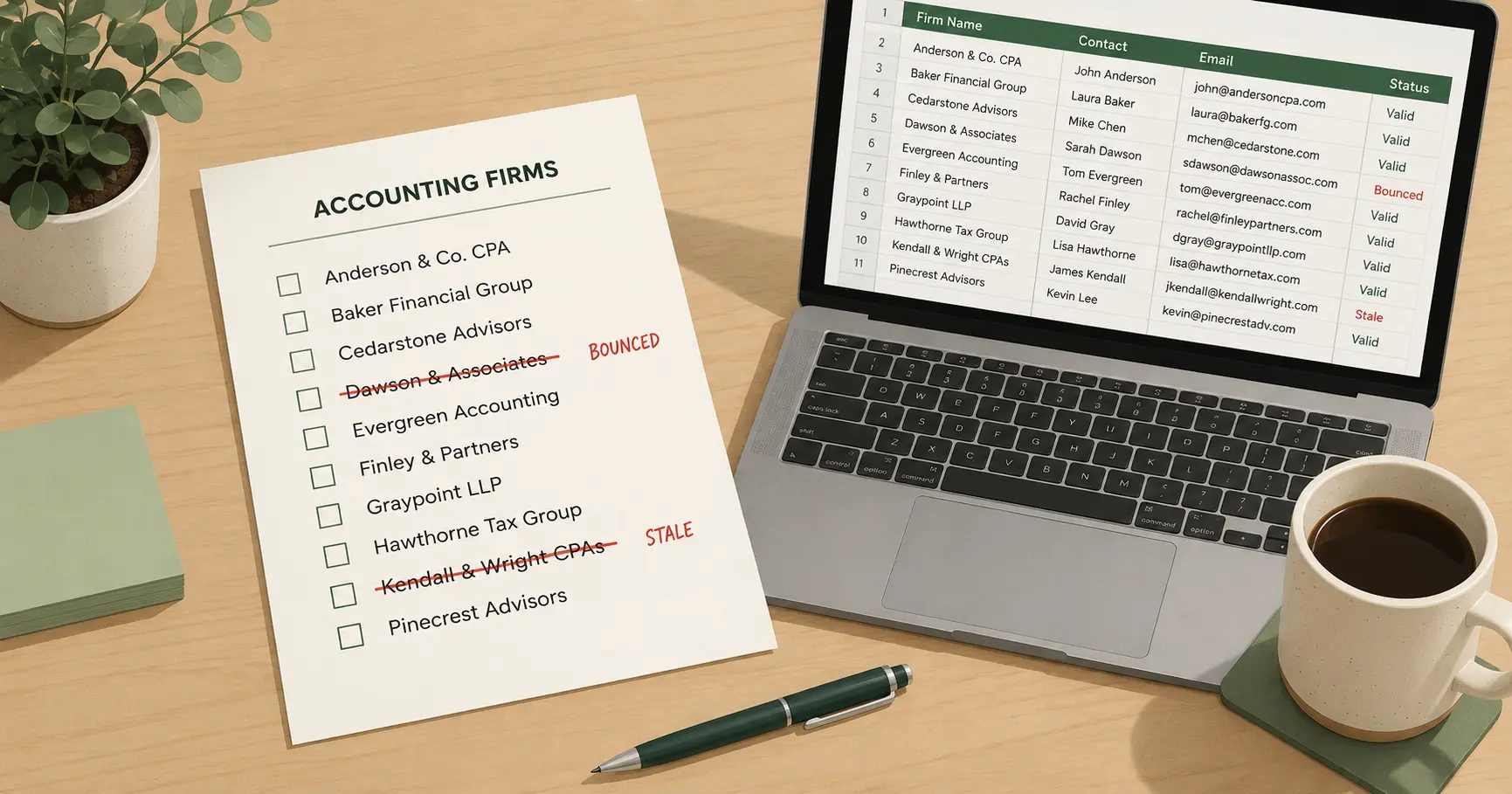
The product was good. The pitch was tested. The list was the problem. The broker had compiled it 11 months earlier. In the accounting industry, 11 months is enough time for dozens of firms on that list to merge, retire, rebrand, or change their email provider. The contacts looked real. Most of them were not.
This is the standard outcome with purchased accountant email lists. This guide walks through why it happens and what to do instead.
Who Actually Needs an Accountant Email List
This guide is not for homeowners looking for a personal accountant. It is for people who sell to accounting firms as a business.
That includes:
- Fintech and software vendors selling practice management tools, payroll software, document automation, or client portals
- B2B service providers selling marketing, IT support, HR services, or compliance tools to accounting practices
- Recruiters and staffing firms placing accountants or support staff at CPA firms
- Insurance brokers selling professional liability (E&O), business insurance, or group health to small firms
- Referral partnership builders who want to establish relationships with CPAs for mutual client referrals
All of these need the same thing: a list of active accounting firms with a verified email address for the person who makes purchasing decisions.
Why Accountant Lists From Data Brokers Fail
Data brokers build their lists once and resell them indefinitely. That model works poorly for most niches. For accounting firms, it breaks especially fast.
Accounting firm structures change often
Solo practitioners retire or transition to part-time with little notice. Small partnerships merge with larger regional firms when one partner exits. Firms rebrand after a merger or after dropping a founding partner's name. A firm called "Johnson & Reed CPA" becomes "Reed Accounting Group" after Johnson retires, and the old email domain goes dark.
A list compiled 12 months ago might be 20-30% inaccurate for these reasons alone. At 18 months, it is worse.
The email goes to the wrong person
Most brokered lists contain office email addresses, not decision maker contacts. You send to info@reedaccounting.com and it lands in a shared inbox checked by an admin. Your message about accounting software gets filtered or deleted before the managing partner sees it.
The decision maker at an accounting firm is the owner, managing partner, or office administrator. Getting to that person requires a name and a direct email. Generic list data rarely includes it.
You are not the only buyer
The same list is sold to dozens of other vendors. The CPA who owns Reed Accounting Group is already getting pitched by competing software vendors, insurance brokers, and service providers who bought the same data. Your outreach is noise in an inbox full of identical approaches.
Response rates on purchased accountant lists routinely fall below 1%. That is a math problem, not a messaging problem.
A Better Approach: Search Google Maps for Active Accounting Firms
Every active CPA firm and accounting office maintains a Google Maps listing. It is where clients find them and leave reviews. It is one of the most reliable indicators that a firm is currently operating.
More importantly, Google Maps updates constantly. A firm that closed last month will have an inactive or removed listing. A firm that just opened will appear within days. You are working with current data, not a snapshot from a year ago.
Here is how to use it.
1. Define who you are actually targeting
Accounting firms vary in size and structure. The pitch and the decision maker differ across types:
Solo practitioners (reviews: 5-30, single name on the listing) are the decision maker themselves. They handle all vendor decisions. Sell them time-saving tools or services that reduce administrative burden. They have limited budgets and respond to pitches tied to ROI.
Small partnerships (reviews: 30-100, firm name with 2-5 people) have a managing partner who handles vendor decisions. They are more likely to buy software, managed IT, or marketing services. They have more budget than solos and can make decisions faster than large firms.
Regional or mid-size firms (reviews: 100+, multiple office locations or team pages on website) have an office administrator or operations manager who handles purchasing alongside partners. These are longer-cycle sales but larger contract values.
Get this wrong and you pitch a solo CPA on an enterprise platform, or pitch a regional firm's managing partner on a $50/month tool. Both fail.
2. Search by location and firm type
Search Google Maps for:
- "CPA near [city]"
- "Accounting firm [city]"
- "Certified public accountant [city]"
- "Bookkeeping services [city]"
- "Tax accountant [city]"
You will get a mixed list of all firm types. The next step sorts them for you.
3. Read the signals to qualify each firm
Google Maps listings tell you more than just the name and phone number.
For solo practitioners:
- Review count under 30 with recent reviews (last 3 months) means they are actively taking clients
- Name on the listing matches a personal name, not a company brand
- Website is a personal practice site, not a multi-partner firm portal
- These are fast to pitch and fast to decide
For small partnerships:
- Review count 30-100 with steady incoming reviews
- Firm name is institutional ("Smith & Partners CPA", "Meridian Accounting Group")
- Website shows 2-5 team members with headshots
- The managing partner or the founder is your target
For mid-size firms:
- Review count 100+ across possibly multiple locations
- "CPA Firm" or "Accounting Group" in the name
- Website has a full team page with 10-30+ names and a designated operations or admin contact
- Decision process is longer, but these firms have budget and buying authority
4. Find and verify the contact
For each firm you are targeting:
Website: Check the "About" or "Team" page. Solo practitioners almost always list their own contact form or email. Partnerships usually list partner names and sometimes direct emails or LinkedIn profiles.
Email pattern: Most small accounting firms use a standard pattern: firstname@firmname.com or firstname.lastname@firmname.com. If the domain is active and the firm has a website, you can often predict and verify the email pattern.
Verification: Before sending, SMTP-verify each address. This checks whether the email exists and accepts mail without actually sending. An unverified list above 5-10% hard bounce rate will damage your sender domain. One verified, clean list protects your deliverability for all future campaigns.
This process works. It is also slow when done by hand at scale.
How Tools Speed This Up
Manually searching Google Maps, copying firm names, hunting websites for partner emails, and verifying each one takes hours per 100 contacts. Across multiple cities, it becomes a full-time research job.
Accountant email list tools automate the sourcing part. You enter a search (accounting firm type + city), and the tool:
- Searches Google Maps in real time
- Returns firm name, address, phone, website, and Google rating
- Discovers the firm's website and generates email patterns for the owner or managing partner
- SMTP-verifies each email before delivering the result
You still read the signals to understand who you are targeting. You still write the message. You skip the hours of manual scraping and guessing.
The result is a list of current, active accounting firms with the decision maker name and a verified email. No bounces. No shared inbox. No 11-month-old data.
For broader context on outreach to financial professionals, see how teams approach mortgage leads using the same Google Maps method. If you are also building email lists across other professional services niches, the approach covered in how to build a real estate agent email list follows the same logic.
What to Do With the List Once You Have It
A good list is only half the job. What you send determines what you get back.
Segment before you write. Solo CPAs, small partnerships, and regional firms each have different constraints and buying triggers. Write a separate email for each segment. A solo CPA cares about saving their own time. A managing partner at a 10-person firm cares about equipping their team. These are different pitches.
Lead with a specific observation. Mention something from the Maps listing or their website: their specialty, their city, the size of their firm. "I found your practice on Google and noticed you focus on small business tax returns in Phoenix" opens better than "I am reaching out to accounting firms."
Keep it short. Accountants are busy professionals who filter email quickly. Three sentences, a specific point of pain, and a clear ask. Under 100 words for the first message.
Follow up. Most responses come on the second or third email, not the first. A simple 3-step sequence spaced 3-4 days apart will outperform a single blast to a larger, unverified list.
Tools That Show Up in Accounting Prospecting Stacks
| Tool | What it does | Strength | Tradeoff |
|---|---|---|---|
| Apollo | B2B contact database | Strong for titled roles at larger firms | Weaker coverage for solo practitioners and small local firms |
| Hunter | Domain-based email finder | Fast when you know the domain | Requires you to find the firm first; does not do discovery |
| ZoomInfo | Enterprise contact data | Deep on mid-market and up | Expensive; overkill for local CPA targeting |
| WebLeads | Live Google Maps search with decision maker emails and SMTP verification | Fresh searches per city, verification built in | Focused on local businesses, not broad database scraping |
Where WebLeads Fits
WebLeads runs a live Google Maps search when you submit a query. You define the location and firm type, and it returns current results with people enrichment and SMTP-verified emails for each firm that has a website. No pre-compiled list. No shared data.
Pricing starts with a free tier, then $24, $69, and $199 per month depending on search volume.
Need verified accountant contacts?
Search any city for CPAs and accounting firms. Get decision maker emails, not stale broker data.
Try WebLeads freeTrial · No sales call · Cancel anytime
The Practical Checklist
- Write a one-sentence ICP: "I sell [what] to [solo CPAs / small partnerships / regional firms] in [geography]"
- Run 3 Google Maps searches matching that ICP
- Read 20 results and practice sorting by firm type using the signals above
- For your top 10 prospects, find the owner or partner name and verify their email
- Write one email for solo CPAs, one for small partnerships
- Test sending to your top 5 in each segment
- Track open rates and replies by segment to see which converts
Pulling It Together
A stale accountant list produces stale results. High bounce rates, spam complaints, wasted outreach budget, and no meetings.
A fresh list built from current Google Maps data, segmented by firm type, with verified decision maker emails and a role-specific message gets replies.
The difference is not the tool. It is the discipline of using current data and writing to the right person with the right pitch.
Need verified accountant contacts?
Search any city for CPAs and accounting firms. Get decision maker emails, not stale broker data.
Try WebLeads freeTrial · No sales call · Cancel anytime